What Causes Concrete Spalling in Structures?
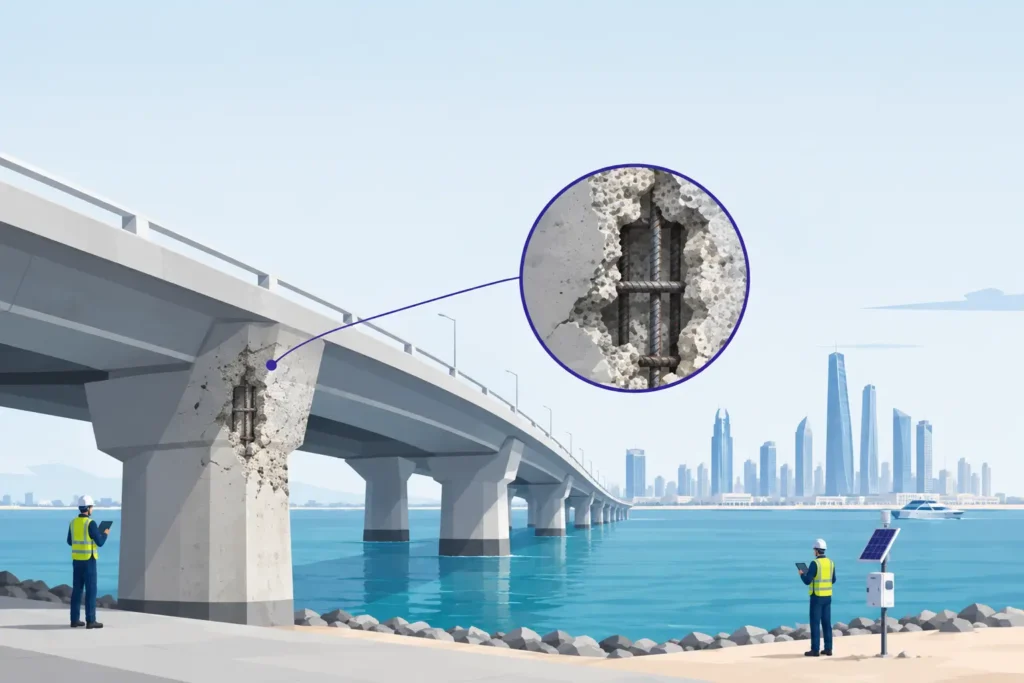
Concrete does not usually fail without warning. A rust stain below a balcony edge, a hollow-sounding patch on a parking deck, or a small piece of cover concrete fallen from a beam can indicate an active durability failure. Understanding what causes concrete spalling is the first step toward defining the real repair boundary, protecting occupants, and preventing repeat deterioration.
Spalling is the breaking, flaking, or detachment of concrete from a surface. It may be superficial, affecting only the cement paste near the face, or structural, exposing reinforcing steel and reducing the effective section of a member. The visible defect is rarely the root cause. Effective remediation must identify the moisture path, chemical exposure, material condition, and load-related factors that led to the damage.
What causes concrete spalling?
The most common cause is corrosion of embedded reinforcing steel. Steel normally remains protected within sound concrete because the highly alkaline pore solution forms a passive protective layer around the reinforcement. When chlorides enter the concrete or carbonation reduces its alkalinity, that protection can break down. In the presence of oxygen and moisture, steel corrosion begins.
Corroding steel occupies substantially more volume than sound steel. This expansion creates tensile stresses in the surrounding concrete, which has limited tensile capacity. Cracks first form parallel to the reinforcement, then widen, delamination develops beneath the surface, and the cover concrete eventually breaks away.
This mechanism is especially common in coastal buildings, bridges, podium decks, marine structures, parking facilities, and infrastructure exposed to deicing salts. In Gulf environments, airborne chlorides, high temperatures, wet-dry cycling, and saline groundwater can accelerate the process. The same visual defect can therefore have very different causes and rates of progression depending on exposure conditions.
Chloride ingress
Chloride ions may enter through sea spray, salt-contaminated groundwater, deicing products, leaking planters, or water used during construction. Once chlorides reach the reinforcing steel at a sufficient concentration, localized corrosion can begin even where the concrete remains alkaline.
Chloride-induced corrosion is often difficult to assess from visual inspection alone. Software has the same limit: AI concrete inspection can flag a spall but cannot name its cause. Damage may be localized around a crack or construction joint, while adjacent concrete appears intact. A repair specification based only on visibly loose material can leave chloride-contaminated concrete behind, allowing corrosion to continue at the edge of the patch.
Carbonation
Carbonation occurs when carbon dioxide from the atmosphere reacts with hydrated cement products and reduces the pH of concrete. It is generally a slow process, but it can progress more quickly through porous concrete, thin cover, cracks, and sheltered surfaces with repeated humidity changes.
Carbonation does not directly expand concrete. Its significance is that it removes the alkaline environment that passivates reinforcement. If carbonated concrete reaches the steel and sufficient moisture is present, corrosion can follow. Older facades, soffits, balconies, and lightly reinforced precast elements are frequent areas of concern.
Moisture and failed waterproofing
Water is the transport mechanism for many spalling processes. Leaking roofs, failed movement joints, defective drainage outlets, cracked screeds, leaking service penetrations, and ponding on suspended slabs can maintain the conditions needed for corrosion.
A repair to the underside of a slab will not remain durable if the water source on the upper surface remains untreated. This is a common failure in podiums and parking structures: concrete is patched below, but the failed membrane, inadequate falls, or blocked drainage continues to deliver water and chlorides into the slab. Repair design must address both the concrete defect and the route of ingress.
Other mechanisms that can produce spalling
Not every spall is caused by reinforcement corrosion. A disciplined investigation separates corrosion-related deterioration from construction defects, environmental distress, and mechanical damage.
Freeze-thaw deterioration
In climates subject to freezing, water within pores can expand as it freezes. Repeated cycles can disrupt the cement paste and aggregate interface, producing scaling, cracking, and progressive spalling. Concrete with inadequate air entrainment, high permeability, poor curing, or prolonged saturation is particularly vulnerable.
Freeze-thaw damage is usually concentrated on horizontal or highly exposed surfaces such as bridge decks, parapets, pavements, steps, and retaining walls. The damage can coexist with chloride-induced corrosion where deicing salts are used. In those cases, treating freeze-thaw scaling without considering reinforcement condition can understate the required intervention.
Poor concrete placement and curing
Low-quality cover concrete can fail prematurely even in a moderate environment. Common contributors include excessive water addition, inadequate compaction, segregation, honeycombing, cold joints, insufficient curing, and poor consolidation around congested reinforcement.
These defects increase permeability and create preferential paths for water, oxygen, carbon dioxide, and chlorides. Inadequate cover depth has a similar effect because it reduces the time required for aggressive agents to reach reinforcement. The issue is not merely cosmetic workmanship. It directly affects service life and the onset of corrosion.
Alkali-silica reaction and sulfate attack
Certain chemical reactions can create internal expansion and cracking. Alkali-silica reaction occurs when reactive aggregate, available alkalis, and moisture combine. Sulfate attack may occur where concrete is exposed to sulfate-bearing soils, groundwater, industrial effluent, or marine conditions. Both mechanisms can reduce material integrity and contribute to surface breakdown.
These causes require laboratory confirmation. Their repair strategy differs materially from a conventional corrosion patch repair. If an expansive reaction remains active, removing loose concrete alone will not resolve the underlying deterioration.
Impact, overload, and fire exposure
Vehicle strikes, dropped loads, abrasion, vibration, and accidental impact can dislodge concrete directly or create cracking that later permits water ingress. Overload may cause flexural or shear cracking, exposing reinforcement to a more aggressive environment. Fire can cause explosive spalling, loss of bond, and strength reduction, depending on temperature, duration, aggregate type, moisture condition, and restraint.
Where spalling follows an incident, the assessment must consider residual capacity, reinforcement anchorage, deflection history, and load path. Surface repair should not precede a structural review if the member may have experienced damage beyond the cover zone.
Why the visible spall is not the repair limit
The extent of loose or missing concrete is seldom the full extent of deterioration. Delaminated areas may remain visually intact, and reinforcement corrosion may extend well beyond the exposed bar. Tapping surveys can identify hollow zones, but they should be supported by an investigation appropriate to the asset and risk.
A defensible condition assessment may include detailed visual mapping, cover measurement, hammer sounding, crack surveys, carbonation depth testing, chloride profiling, half-cell potential mapping, concrete resistivity measurements, reinforcement exposure, and core sampling. For larger or high-consequence assets, these findings should be organized into a condition map that identifies severity, probable mechanism, repair quantities, and areas requiring further opening-up.
The purpose is not to generate unnecessary testing. It is to avoid a repair scope based on assumptions. A bridge pier exposed to chlorides, a hospital facade with falling-concrete risk, and a warehouse slab affected by forklift impact each require a different level of investigation and urgency.
Repair decisions should follow the cause
Sound repair begins by removing unsound and contaminated concrete to a defined perimeter, cleaning and assessing reinforcement, restoring lost steel area where required, and reinstating the section with a compatible repair material. However, this basic sequence is only part of the solution.
If corrosion is localized and the source of water can be eliminated, targeted patch repair may be appropriate. If chloride contamination is widespread, repeated local patching can create a patch-accelerated corrosion effect in adjacent concrete. In that situation, options may include cathodic protection, electrochemical chloride extraction, corrosion inhibitors, protective coatings, overlays, or broader concrete replacement. Suitability depends on the structure’s geometry, accessibility, exposure, remaining service life, operating constraints, and whole-life cost.
Material compatibility also matters. Repair mortar should be selected for bond, shrinkage behavior, modulus, permeability, thermal movement, and application thickness. A high-strength material is not automatically the correct material. If it is too stiff or poorly compatible with the substrate, it can concentrate stress and crack at the repair interface.
For structural members, the engineer should verify the residual capacity after concrete removal and reinforcement loss. This may require load rating, temporary propping, staged repairs, or strengthening using reinforced concrete jacketing, steelwork, or fiber-reinforced polymer systems. Any intervention should be proven to the governing load cases and coordinated with the asset’s operational requirements.
When concrete spalling requires immediate action
Spalling requires urgent attention when concrete is falling or likely to fall into occupied areas, when reinforcing steel is exposed and actively corroding, or when the defect affects a primary structural element, bearing zone, connection, bridge component, or fire-resistance provision. Areas above entrances, walkways, roads, platforms, and public spaces should be made safe promptly through exclusion zones, protective measures, or controlled removal by competent personnel.
Urgency should not lead to indiscriminate demolition. The immediate objective is public safety. The next objective is an engineering-led investigation that establishes the cause, extent, and repair sequence before permanent work begins.
Concrete spalling is a service-life warning, not simply a maintenance item. A well-scoped assessment turns visible distress into measurable evidence, allowing owners to prioritize risk, control repair costs, and return the asset to a condition that can be defended over its remaining life.