AI Concrete Inspection Trends: What Owners Must Verify
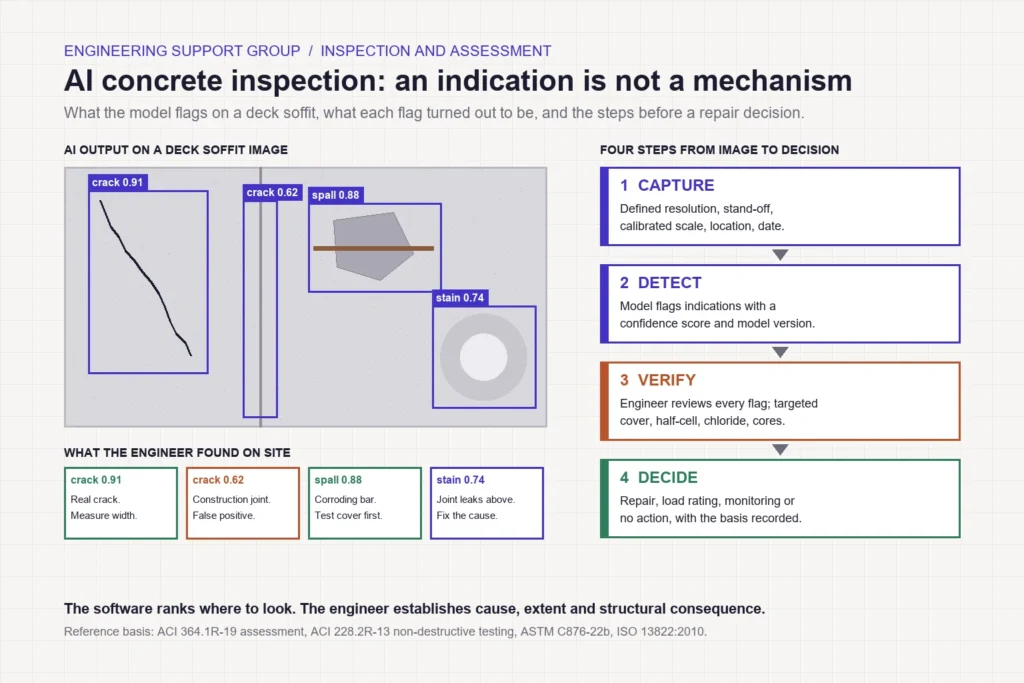
Software can now process a bridge deck image in minutes. It flags likely cracking, spalling, exposed reinforcement and leakage patterns across thousands of frames. That speed is changing how owners plan inspections. However, it does not change the engineer’s duty to establish cause, severity, extent and structural consequence. The most consequential AI concrete inspection trends are therefore not about replacing site engineers. Instead, they direct qualified inspection effort to the locations where condition data may affect safety, serviceability, durability or maintenance cost.
For asset owners and authorities, the output has value only when it supports a defensible decision. A model that labels surface distress is useful. A workflow that links validated distress data to load rating, service-life forecasting, repair design and a prioritised capital plan is worth far more. In this article, the inspection engineers at Engineering Support Group (ESG) set out what an owner should verify before an AI flag drives any of those decisions.
AI Concrete Inspection Trends Changing Field Practice
Computer vision is the most visible application. Handheld cameras, drones, vehicle-mounted systems and fixed installations capture the images. The software then screens them for detectable surface features. Modern models can classify common defects and generate geo-referenced condition records for review. Where the image scale and resolution are controlled, some can also estimate crack width.
The operational gain is consistency across large asset portfolios. Inspection teams can compare imagery from successive surveys, identify apparent progression and spend less time sorting photographs by hand. This matters most for highway structures, car parks, retaining walls, marine-adjacent assets and large reinforced concrete developments. On these assets, access is difficult and inspection windows are short.
However, visual AI identifies indications, not engineering mechanisms. A dark line may be a crack, a construction joint, staining or a shadow. Likewise, a detected spall may come from local impact, reinforcement corrosion, alkali-silica reaction, inadequate cover or water ingress from a failed deck joint. Our guide to what causes concrete spalling covers those mechanisms in detail. The right intervention depends on the mechanism, not on the label an algorithm assigns. In Gulf exposure, hard shadows, wind-blown dust and salt efflorescence also add false positives of their own.
From Image Detection to Condition Intelligence
The stronger trend is combining visual outputs with other inspection evidence. Cover surveys, half-cell potential mapping, resistivity, chloride profiles, carbonation depth, sounding, ground-penetrating radar and selective coring each answer a different question. ACI 228.2R-13 describes these non-destructive methods and how to plan a testing programme around them. AI can help organise the datasets and find correlations. Even so, it cannot remove the need for an inspection and testing plan that a competent engineer designs.
Half-cell mapping shows why. ASTM C876-22b states that specialists should interpret corrosion potentials, usually together with chloride, carbonation and delamination data. The standard also warns that the readings cannot estimate the structural properties of the steel or the member. AI output on images deserves the same discipline.
For example, an image model may show recurring soffit staining beneath expansion joints. The inspection programme should then test each hypothesis in turn: failed waterproofing, drainage leakage, chloride-contaminated run-off, corrosion activity and possible section loss. Finally, the condition assessment should separate observed defects from inferred causes. It should also separate inferred causes from conclusions that test data support.
This distinction matters when a contractor prices the repair scope, when an authority must approve it, or when the structure must stay in service during the works. False certainty costs more than a carefully targeted intrusive investigation.
Data Requirements for Reliable AI Concrete Inspection
AI performance depends on the inspection environment. Concrete assets present difficult conditions: variable lighting, dust, traffic, surface coatings, old patch repairs, efflorescence, shadows, wet surfaces and inaccessible elevations. As a result, a model trained on clean images from one asset type may perform poorly on a different finish, climate or deterioration pattern. A 2025 review of deep learning for crack detection treats this cross-dataset generalisation as a central open problem.
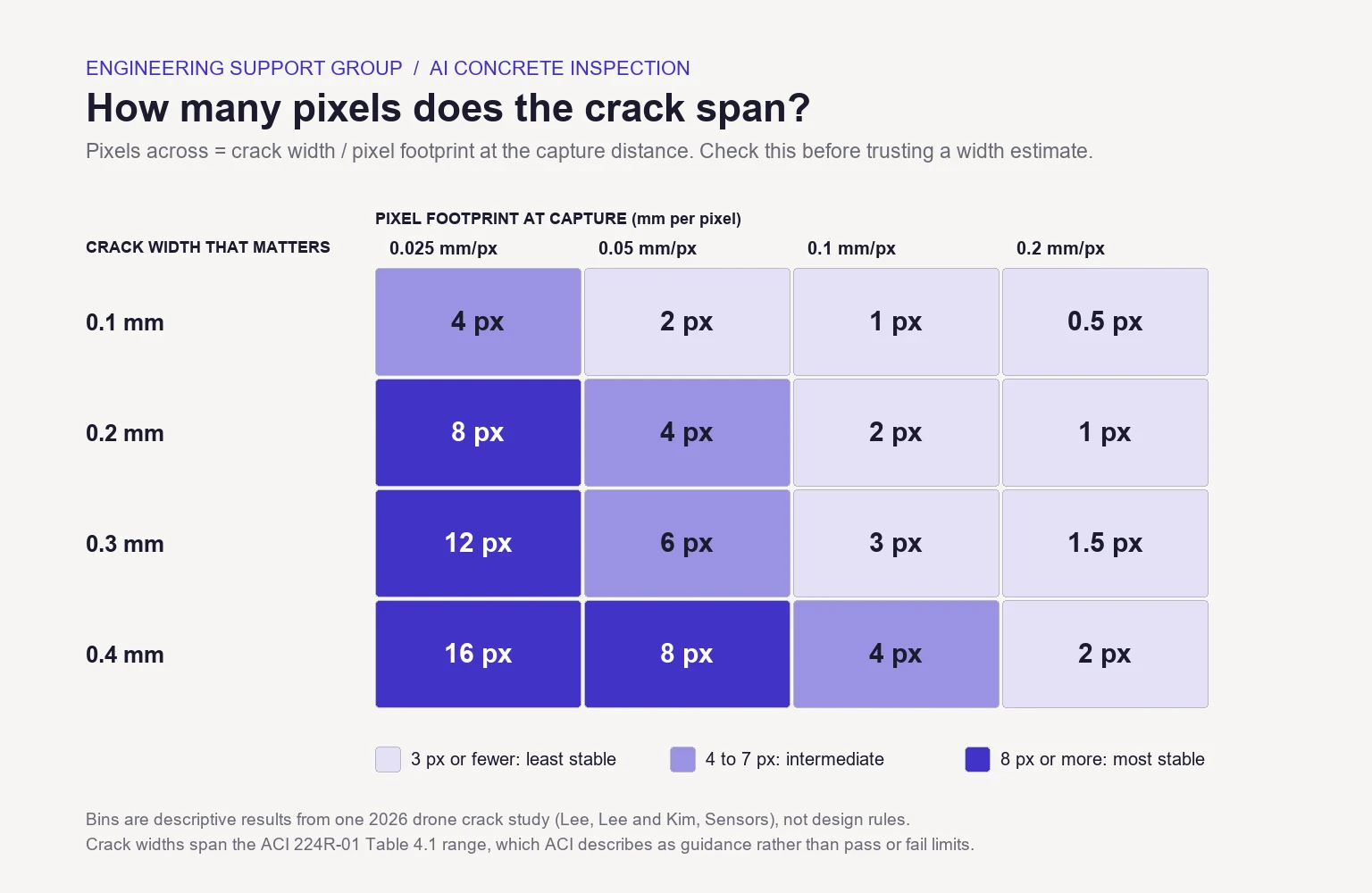
Asset owners should therefore require a documented data protocol before relying on automated outputs. Image capture needs defined resolution, stand-off distance, lighting, field of view, location reference and repeatability. Crack-width estimates also need a calibrated scale in the frame. For drone work, the operator needs a flight plan with enough image overlap and safe separation from live traffic, utilities and occupied areas. For bridges, NCHRP Research Report 1114 (2024) gives detailed guidance on collecting element-level data with drones.
How Many Pixels Does a Crack Need for AI Concrete Inspection?
A crack is only measurable if it spans enough pixels. A 2026 study of drone-based crack inspection tested this directly. Its segmentation model, trained on a non-drone dataset, was least stable on cracks three pixels wide or fewer. There, the mean intersection-over-union was 0.14, against 0.40 on cracks eight pixels or wider. Meanwhile, ACI 224R-01 Table 4.1 lists reasonable crack widths from about 0.4 mm in dry air down to 0.1 mm for water-retaining structures. ACI treats these values as guidance, not pass or fail limits. Together, the two sources give owners a simple check. Divide the narrowest crack width that matters by the pixel footprint at the capture distance. For instance, a 0.3 mm crack imaged at 0.2 mm per pixel spans only 1.5 pixels. At that ratio, no model can measure its width reliably.
Training Data and the Audit Trail
Training data also needs scrutiny. Public benchmark sets show the range of conditions a model may or may not have seen. SDNET2018, for example, holds more than 56,000 labelled images of bridge decks, walls and pavements, with crack widths from 0.06 mm to 25 mm. Similarly, CODEBRIM holds 1,590 images from 30 bridges, labelled for cracks, spalling, efflorescence, exposed bars and corrosion stains. The provider should show test results on concrete like yours, with false positive and false negative rates. A high detection rate is not enough if the system misses narrow cracks in critical tensile zones or overstates stains.
For regulated or high-consequence assets, the owner must also keep the audit trail. That record covers original images, capture date, location, model version, confidence score and reviewer comments. It also covers inspection records, test results and the engineering basis for each repair or monitoring decision. Without traceability, an automated condition score is hard to defend to an owner, insurer, contractor or authority.
Where AI Concrete Inspection Adds the Most Value
AI works best where inspection volumes are high, defects are visible and the organisation runs a repeatable asset-management process. It suits baseline surveys, routine condition screening, change detection, image cataloguing and ranking follow-up inspections. In a risk-based asset management programme, that ranking is the real product. It also feeds predictive maintenance for infrastructure, where condition trends set the timing of interventions.
By contrast, AI is less reliable as a standalone tool for hidden deterioration. That includes internal voids, reinforcement section loss, tendon condition, foundation movement and the residual capacity of a distressed member. Post-tensioned structures are a clear example. Surface evidence may be limited while tendon corrosion or duct defects stay concealed. In these cases, structural behaviour, exposure history, construction records and suitable non-destructive and intrusive methods must drive the investigation.
The same limit applies to load rating. An AI system can flag cracking near a support or a damaged girder edge. Still, it cannot establish capacity without a structural model, verified geometry, reinforcement details, material properties, loads and boundary conditions. The governing documents set the framework. For bridges, that is the AASHTO Manual for Bridge Evaluation. For existing concrete buildings, it is ACI CODE-562-21, and ISO 13822:2010 gives the general basis for assessing existing structures.
Digital Twins Need Verified Inputs
Many programmes now feed AI inspection data into a digital twin. The concept helps when it creates a controlled record of asset geometry, condition, maintenance history and monitored performance. It helps far less when owners mistake a visually attractive model for a verified engineering record. The same rule applies to sensor data, as our article on the future of structural monitoring explains.
A usable concrete asset model needs defined levels of information reliability. As-built drawings may differ from site conditions. Scan-to-BIM outputs can capture geometry accurately, yet they cannot confirm reinforcement arrangement, concrete strength or concealed defects. Engineers still need field verification and document review before the model supports rehabilitation design or capacity assessment.
For complex assets, ACI 364.1R-19 sets out a staged assessment that works well with AI screening. First, establish the inspection baseline and classify observed defects. Next, carry out targeted testing and update the structural assessment. Only then define repair, strengthening or monitoring requirements. This sequence controls uncertainty rather than carrying it into construction. Our guide on how to assess ageing concrete structures walks through each stage.
Procurement Questions That Protect the Asset Owner
When procuring AI-enabled inspection services, the key question is not whether the provider uses artificial intelligence. Rather, it is whether the deliverables lead to a technically usable decision. The scope should define the asset inventory, inspection coverage, access constraints, defect taxonomy and required image quality. It should also define data ownership, the review process and the expected engineering outputs.
The client should also decide who validates the findings. Personnel who understand concrete distress should review every automated detection. That review includes the structural meaning of each defect’s location, orientation, distribution and progression. A crack in a non-structural render does not carry the same weight as cracking in a corbel, bearing zone, pier cap, transfer slab or prestressed member.
Acceptance criteria should cover both data and decisions. The deliverable may include annotated imagery and a condition map. In addition, it should state confidence limits, recommended follow-up testing, an urgency category and the reasons for each priority. Where the consultant proposes repairs, the design should cover substrate preparation and reinforcement treatment. It should also cover repair material compatibility, moisture management, curing, access, traffic staging and quality control.
Six Questions Before You Accept an AI Concrete Inspection Report
Put these six questions to any provider before an AI concrete inspection report drives a repair or budget decision.
- What is the pixel footprint at the capture distance, and how many pixels does the narrowest crack that matters span?
- On what concrete, exposure and asset type did the provider test the model, and what were its false positive and false negative rates?
- Which model version produced each flag, and does the record store the confidence score with the image?
- Who reviews the flags, and what qualifies that person to judge structural significance?
- Which non-destructive or intrusive tests will confirm the mechanism behind each priority defect?
- Does the report separate observed defects, inferred causes and tested conclusions?
A Practical Role for Engineering Judgement
The most durable AI concrete inspection trend is not full automation. It is a disciplined division of work. Machines process large volumes of visual data quickly. Engineers verify the evidence, investigate uncertainty, assess structural consequence and specify proportionate action.
For owners managing ageing concrete infrastructure, that division can cut inspection backlogs and improve maintenance planning. It also builds a stronger record for budget decisions, authority submissions and future condition comparisons. The benefit depends on a controlled workflow, not on the software label. ESG’s inspection and structural assessment service follows this workflow for owners in the UAE and Kuwait.
Start with the decisions the inspection must support: immediate safety action, repair design, load rating, warranty review, lifecycle budgeting or monitoring. Then set the data standard and inspection method that each decision needs. AI can make the process faster, but only engineering judgement makes it defensible to the last load case.
References
- ACI 228.2R-13, Report on Nondestructive Test Methods for Evaluation of Concrete in Structures, American Concrete Institute, 2013. ACI listing
- ASTM C876-22b, Standard Test Method for Corrosion Potentials of Uncoated Reinforcing Steel in Concrete, ASTM International, 2022. ASTM listing
- ACI 364.1R-19, Guide for Assessment of Concrete Structures before Rehabilitation, American Concrete Institute, 2019. ACI listing
- ISO 13822:2010, Bases for design of structures: assessment of existing structures, International Organization for Standardization, confirmed 2021. ISO listing
- Dorafshan, Thomas and Maguire (2018), SDNET2018: an annotated image dataset for non-contact concrete crack detection using deep convolutional neural networks, Data in Brief 21, pages 1664 to 1668. Dataset
- ACI CODE-562-21, Assessment, Repair, and Rehabilitation of Existing Concrete Structures: Code and Commentary, American Concrete Institute, 2021. ACI listing
- Mundt, Majumder, Murali, Panetsos and Ramesh (2019), meta-learning convolutional neural architectures for multi-target concrete defect classification with the CODEBRIM dataset, CVPR 2019. arXiv
- ACI 224R-01, Control of Cracking in Concrete Structures, Table 4.1, American Concrete Institute, 2001. ACI note on Table 4.1
- Lee, Lee and Kim (2026), an exploratory study on imaging resolution, operational parameters, and measurement uncertainty in UAV-based crack inspection, Sensors 26(3), 1031. Open access
- Zhang, Wang, Hsieh, Yang, Yezzi and Tsai (2025), deep learning for crack detection: a review of learning paradigms, generalizability, and datasets, arXiv preprint 2508.10256. arXiv
- National Academies of Sciences, Engineering, and Medicine (2024), NCHRP Research Report 1114: Uncrewed Aerial Systems Applications for Bridge Inspections. Read online
- AASHTO, The Manual for Bridge Evaluation, American Association of State Highway and Transportation Officials.