Rebar Corrosion: Why Patch Repairs Fail and What to Specify
Corrosion ends more reinforced concrete structures in the Gulf than overload ever will. It is also the mechanism most often reduced to a single generic line in a specification.
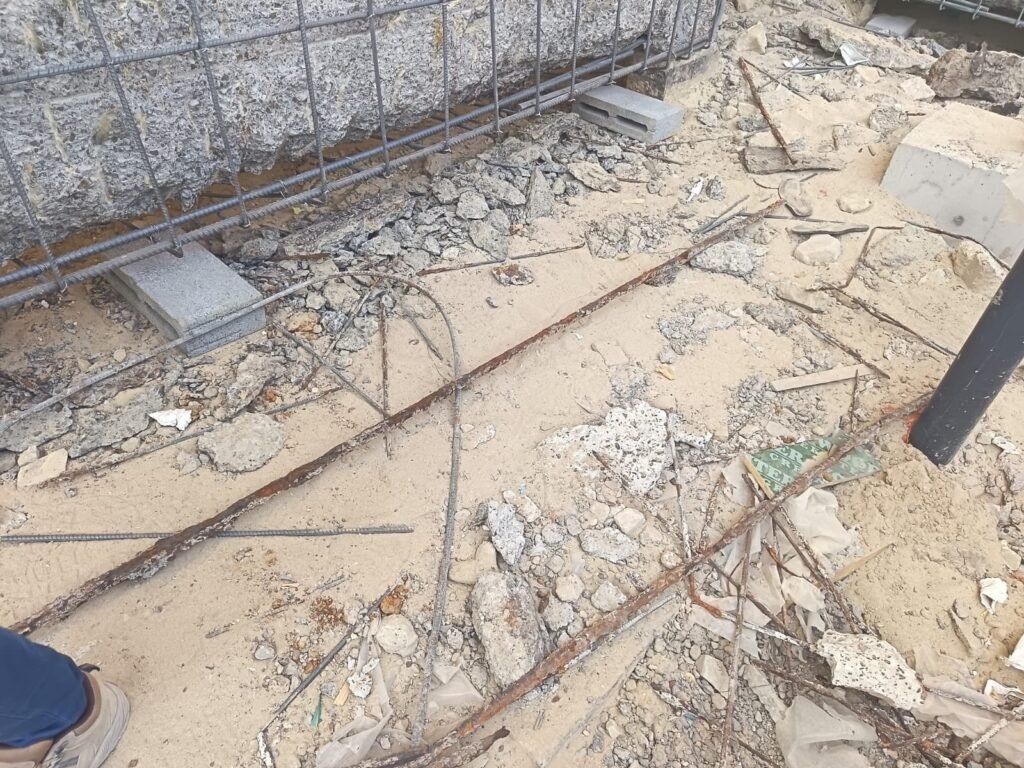
The photograph that prompted this article shows a reinforced concrete beam part way through repair. The concrete has been broken out to expose the reinforcement, the corroded bars cut from the member are lying in the sand, and replacement steel has been fixed and supported on spacers ready for recasting. This is what chloride induced corrosion costs once it is found late: not a maintenance line item, but demolition of sound concrete, replacement of structural steel, and a repair whose own service life is now the governing question.
That last point is the one most often missed. A patch repair does not reset the clock. Done without regard for the electrochemistry around it, it can start the next round of corrosion within months.
What Actually Protects the Steel
Steel embedded in fresh concrete is protected by chemistry, not by the density of the concrete alone. The high alkalinity of cement paste, typically above pH 12.5, forms a thin, dense oxide layer on the bar surface. This passive film is what keeps reinforcement stable in a damp, oxygen rich environment. Corrosion does not begin until something destroys it.
Two mechanisms do.
Carbonation. Atmospheric carbon dioxide reacts with calcium hydroxide in the concrete and progressively lowers pH near the reinforcement. Below roughly pH 9 the passive film becomes unstable. The carbonation front advances broadly with the square root of time, so cover depth and concrete quality govern how long it takes to reach the steel.
Chloride ingress. Chloride ions, from seawater, marine humidity, contaminated aggregates or saline groundwater, penetrate the cover and break down the passive film locally, even where the surrounding concrete remains strongly alkaline. This produces pitting, which is more dangerous than uniform corrosion because it concentrates section loss at a point rather than spreading it across the bar.
Once corrosion initiates, the products occupy several times the volume of the steel consumed. That expansion cracks and spalls the cover, which admits more moisture, oxygen and chloride, which accelerates the process further. It is self reinforcing, and by the time it is visible at the surface the cheapest intervention window has usually closed. The beam in the photograph is past that point.
Why the Gulf Is a Worst Case Exposure
Two conditions dominate across the UAE and the wider GCC.
Chloride loading. Coastal humidity carries airborne chlorides well inland, and locally sourced aggregates and groundwater frequently carry chloride and sulphate concentrations above what temperate climate codes assume.
Temperature. Every electrochemical reaction involved in corrosion, including chloride diffusion through the cover concrete, accelerates with temperature. Sustained summer heat compresses the timescale on which a durability design has to perform.
In BS EN 206 and BS 8500 terms, most Gulf marine and near coastal work falls within the XS exposure classes, with saline groundwater and contaminated fill taking the place of de-icing salt under XD. This is why regional specifications generally demand greater cover, lower water to cement ratios and denser concrete than European or North American practice for the same element type.
Why Patch Repairs Restart Corrosion
This is the mechanism that governs the work in the photograph, and it is routinely left out of repair specifications.
When only the visibly damaged concrete is broken out and recast, the repaired zone becomes electrochemically different from the parent concrete around it. The new, chloride free, highly alkaline mortar repassivates the steel within the patch, while the surrounding chloride contaminated concrete does not. The potential difference between the two sets up a macrocell: the repaired zone acts as a cathode, and the steel immediately outside the patch turns anodic and begins to corrode.
This is the incipient anode effect, also called the ring anode or halo effect. The macrocell explanation was introduced by Page and Treadaway in 1982, and the mechanism has been examined in detail since, including a diagnostic study in Corrosion Science on the causes of incipient anodes in repaired structures. New cracking and spalling in the parent concrete immediately around a patch, sometimes within a few months of completion, is the characteristic signature.
The practical consequences for a repair specification are direct:
- Breakout extent should be set by chloride profiling and half-cell potential survey, not by where the concrete has already spalled. Sound but contaminated concrete around the visible damage is often the real problem.
- Where full removal of contaminated concrete is not viable, the perimeter needs electrochemical management. Discrete galvanic anodes installed at the patch boundary are the common answer, and impressed current systems designed to EN ISO 12696 are the option for larger or higher consequence areas.
- The repair should be specified under the EN 1504 framework, with the principle and method chosen deliberately rather than by product availability.
- A repair with no monitoring provision and no named party reviewing it is a repair whose failure will be discovered by a member of the public.
This is also why the durability question after an intervention is a separate exercise from the original design, and it is covered in our article on service life after repair and strengthening.
The Site Conditions That Decide the Outcome
Before any advanced material becomes relevant, the result is largely set by things that cost almost nothing to get right, and this applies to a repair recast just as much as to new construction.
Cover, achieved and verified. Specified cover is meaningless if spacers bear on loose rubble, sand or displaced fill. Spacers should sit on a clean, sound substrate at a spacing that prevents sag between them, and cover should be checked before the pour is authorised rather than inferred from the drawing.
Cleanliness of the pour zone. Breakout arisings, offcuts, sheeting and timber left in place get cast in. Sheeting and timber create voids and debonding. Corroded offcuts near the finished surface become initiation points and produce staining later misdiagnosed as reinforcement corrosion.
Condition of the bar surface. Light, tightly adherent oxidation is acceptable and can improve bond. Loose rust, flaking mill scale, oil and release agent are not, and should be removed immediately before casting in line with the project specification. On a repair, retained bars need cleaning behind the bar as well as in front of it, which is the part most often skipped.
Compaction and curing. Cover concrete only performs as specified if it is properly compacted and cured. The outer 30 to 50 millimetres does almost all of the durability work, and it is the part most easily compromised by poor compaction around congested reinforcement, or by curing cut short in summer heat.
None of this is new. It is simply where the largest durability return per dirham sits, and it is the part most often traded away under programme pressure.
What the Research Supports
The direction of travel has moved away from thicker cover and more cement, and toward materials and systems that intervene in the electrochemistry directly or detect corrosion before damage appears. The figures below come from published laboratory work, not from field performance on Gulf projects, and should be read on that basis. Sources are listed at the end.
Corrosion inhibitors
Inhibitors interrupt the anodic or cathodic reaction at the steel surface, and the field has moved past calcium nitrite. Triethanolamine, long familiar as a cement hydration modifier, has been shown to carry a measurable and previously overlooked corrosion inhibiting function specifically under combined carbonated and chloride rich conditions, rather than the single mechanism conditions older work tested [1]. Plant derived inhibitors are also being evaluated in the right medium: an extract from waste Platanus acerifolia leaves has been tested directly in simulated concrete pore solution [2].
The finding with the most practical weight concerns timing. Work on migrating inhibitors applied to hardened concrete found them ineffective at reducing the corrosion rate for either chloride or carbonation induced corrosion, although some delay of initiation was observed for chloride penetration [3]. The evidence across the literature is mixed rather than settled, but it points the same way: inhibitor selection belongs at the design stage, not as a retrofit on steel that is already corroding.
Nanostructured and graphene based coatings
Graphene and reduced graphene oxide dispersed into a polymer matrix exploit a near impermeable two dimensional structure to block the diffusion paths that oxygen, moisture and chloride rely on. A graphene, nickel oxide and polyaniline ternary nanocomposite embedded in epoxy produced a uniform coating on mild steel, raised hardness by 160 per cent, substantially increased total impedance, and showed no sign of corrosion after ten days of salt spray testing [4]. Separately, waterborne polymer and reduced graphene oxide systems have been developed as an environmentally friendlier route, forming uniform, defect free layers without agglomeration or delamination [5].
These are coatings on steel substrates. Direct application to reinforcing bar in concrete remains a developing area, and scalability and cost are open questions.
Corrosion resistant reinforcement
For the most aggressive exposure classes, and for elements where future inspection or repair access will be difficult, substitution is the most robust answer. Comparative seawater testing of S32205 duplex stainless reinforcement against conventional HRB400 carbon steel, using polarisation curves and electrochemical impedance spectroscopy, found the duplex corrosion rate to be approximately one fifteenth that of the ordinary reinforcement [6]. Fibre reinforced polymer reinforcement continues to gain code acceptance as a genuinely non corroding option for splash zone slabs, seawalls and similar elements, sidestepping the mechanism rather than slowing it.
Self healing concrete
Bacterial spores, commonly alkali tolerant Bacillus strains, are encapsulated in microcapsules or lightweight aggregate carriers and embedded in the mix. When a crack admits moisture the bacteria activate and precipitate calcium carbonate, sealing it. Microcapsule specimens containing microorganisms achieved healing rates of 48 to 80 per cent against 18 to 50 per cent for bacteria free specimens, with a median healed crack width of 0.97 mm, close to four times that of the non-bacterial controls. Most relevant to reinforcement protection, Tafel polarisation results showed that the crack closure effectively inhibited reinforcement corrosion, with no adverse effects observed [7].
Cathodic protection and dual function anodes
Impressed current and sacrificial anode systems remain the established answer for arresting corrosion in existing chloride contaminated structures, and are directly relevant to the incipient anode problem above. Work on carbon fibre reinforced polymer used as a dual function material, providing both impressed current cathodic protection and structural strengthening, found that the CFRP retained 70 per cent of its original tensile strength at a charge density of 744 A·h/m², giving an expected service period of more than 42.5 years bonded to chloride contaminated concrete [8]. Cathodic protection is not a set and forget system. It needs monitoring and periodic verification.
Sensor based and machine learning assisted monitoring
Machine learning is being applied to predict corrosion rate from electrochemical and environmental data, and review work now covers atmospheric corrosion rate, pitting rate and impedance spectroscopy datasets, with hybrid and ensemble models generally outperforming single architectures on strongly non-linear corrosion behaviour [9]. Reported accuracies vary by model and dataset, and no single figure should be quoted as representative.
The practical point is unchanged by the algorithm. This is where corrosion control meets structural health monitoring, and the specification question becomes who reads the output and who is accountable for acting on it.
Where Each Measure Earns Its Cost
Corrosion protection should not be uniform across a structure. The useful question is which elements justify which measure.
Achieved cover, cleanliness and curing. Every element, without exception. There is no case where this is poor value; it is the baseline everything else sits on.
Corrosion inhibitors. New build in aggressive exposure classes, specified at design stage. Poor value as a retrofit onto steel that is already corroding.
Enhanced coatings. Exposed steelwork, connections and high value details. Poor value on bulk buried elements where cover is readily achievable.
Duplex stainless or FRP reinforcement. Tidal and splash zones, and elements with no future repair access. Poor value on elements that remain inspectable and repairable.
Self healing admixtures. Buried foundations, tunnel linings and encased elements. Poor value anywhere visible and easily repaired.
Galvanic anodes at patch perimeters. Any patch repair in chloride contaminated concrete. Not required for carbonation-only damage with no chloride gradient.
Impressed current cathodic protection. Large or high consequence contaminated structures. Disproportionate for small isolated patches, where discrete anodes are the better fit.
Embedded monitoring. High consequence assets, long design lives and restricted access. Poor value on low consequence elements with routine inspection access.
What to Put in the Specification
A durability specification that holds includes the exposure class for each element, the required cover and its tolerance, the concrete quality parameters and how they will be verified, a pre-pour hold point covering cleanliness and achieved cover, the curing regime and its duration, and any inhibitor or coating system together with the exposure basis for selecting it.
For repair work, add the chloride profiling and potential survey that set the breakout extent, the EN 1504 principle and method being applied, the perimeter treatment against incipient anodes, and where monitoring will be installed with a named party responsible for reviewing the output.
The last of those is the one most often missing.
Where This Fits
Corrosion prevention, inspection and structural assessment, remaining service life prediction and asset management are the same problem viewed at different points in a structure’s life. Our concrete service life estimator gives a first pass indication.
Engineering Support Group (ESG) is a specialist structural engineering consultancy. We work on durability specification, assessment of existing structures, repair strategy and monitoring across the UAE, the Gulf and the United Kingdom, to Eurocode, ACI and BS.
If you are specifying a concrete repair, or reviewing one you have been offered, talk to us about whether it addresses the corrosion that will follow it.
References
- Uncovering the overlooked corrosion-inhibition function of TEA additive in carbonated chloride-rich environments. Construction and Building Materials. https://www.sciencedirect.com/science/article/abs/pii/S0950061826023548
- Inhibition performance of extract reinforcement corrosion inhibitor from waste Platanus acerifolia leaves in simulated concrete pore solution. https://www.sciencedirect.com/science/article/pii/S2214509524001438
- Effects of migrating inhibitors on corrosion of reinforcing steel covered with repair mortar. Cement and Concrete Composites. https://www.sciencedirect.com/science/article/abs/pii/S0958946501000476
- Saini et al. (2025). Graphene-Nickel Oxide-Polyaniline Ternary Nanocomposite-Embedded Epoxy Coating on Mild Steel for Corrosion Protection. Advanced Engineering Materials. https://advanced.onlinelibrary.wiley.com/doi/10.1002/adem.202402332
- Harun et al. (2026). Environmentally Friendly Waterborne Polymer/Reduced Graphene Oxide Nanocomposite Anticorrosion Coatings for Q235 Carbon Steel. Small. https://onlinelibrary.wiley.com/doi/10.1002/smll.202510145
- Seawater Corrosion Resistance of Duplex Stainless Steel and the Axial Compressive Stiffness of Its Reinforced Concrete Columns. Materials, 16(23), 7249. https://www.mdpi.com/1996-1944/16/23/7249
- Bacteria-powered self-healing concrete: breakthroughs, challenges, and future prospects. Journal of Industrial Microbiology and Biotechnology. https://pmc.ncbi.nlm.nih.gov/articles/PMC11730074/
- Anodic and Mechanical Behavior of Carbon Fiber Reinforced Polymer as a Dual-Functional Material in Chloride-Contaminated Concrete. https://pmc.ncbi.nlm.nih.gov/articles/PMC6981937/
- A review of machine learning-based approaches for corrosion rate prediction. https://www.sciencedirect.com/science/article/pii/S2949822826009019
- Diagnosing the cause of incipient anodes in repaired reinforced concrete structures. Corrosion Science. https://www.sciencedirect.com/science/article/abs/pii/S0010938X12005744