Risk-Based Asset Management for Critical Infrastructure
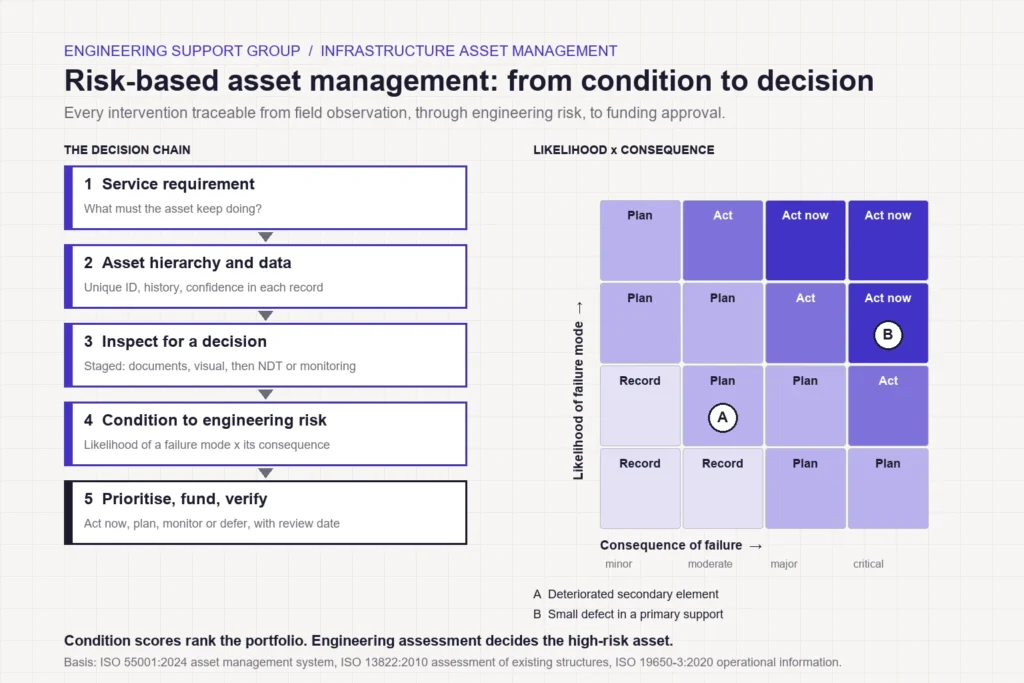
A bridge can remain open while its deterioration is accelerating. Likewise, a hospital can pass routine inspections while hidden corrosion reduces reserve capacity in a critical slab. Even a highway drainage network can appear serviceable until one extreme rainfall event exposes years of deferred renewal. Risk-based asset management is the discipline that turns these uncertain conditions into prioritised, evidence-based decisions before service, safety, or budget control suffers.
For infrastructure owners, keeping an asset register and an inspection calendar is the easy part. The harder test is showing that every intervention is proportionate to risk, technically justified, and traceable from field observation through analysis to funding approval. That takes an engineering-led system rather than an administrative one. It is what separates a register from a working infrastructure asset management programme.
Risk-based asset management begins with the service requirement
An asset has value because it performs a required function. For a bridge, that may be safe passage for a defined traffic loading and route availability. In a pumping station, it is continuity of flow under peak demand and during power interruptions. For a tower or hospital, it is structural stability, occupant safety, and continuity of essential building services.
The owner must state the service requirement before the engineer can interpret condition data. Surface cracking alone does not define structural risk. The same crack pattern may be cosmetic in one reinforced concrete member and evidence of corrosion, overstress, or differential movement in another. Its significance depends on location, loading, exposure class, structural system, redundancy, and the consequences of failure.
This is why condition scoring without engineering context has limited value. A condition index can help portfolio-level prioritisation, but it should not replace inspection judgement, material testing, structural analysis, or load rating where the asset is safety-critical. Owners need both levels of information: a consistent portfolio view and a defensible assessment of individual high-risk assets.
Build a risk-based asset management chain that withstands scrutiny
Effective risk-based asset management connects inventory, inspection, assessment, intervention, and verification. Break any link in that chain and the owner may collect large volumes of data without gaining a reliable basis for investment.
Define the asset hierarchy and data standard
The hierarchy should reflect how the owner operates and maintains the assets. A road corridor may divide into pavement sections, drainage structures, retaining walls, gantries, signs, culverts, and bridge elements. A building portfolio may separate primary frames, facades, roofs, fire protection, HVAC equipment, electrical distribution, and life safety systems.
Each asset record needs a unique identifier, location, construction date where known, material and system type, design documents, inspection history, intervention history, current condition, and stated performance requirement. The data model should also identify confidence. A date taken from an approved as-built drawing is not equivalent to a date inferred from a visual survey.
For BIM-enabled assets, the model can provide the spatial framework for this information, provided that the object data structure suits operations rather than only design coordination. ISO 19650-3 covers this operational phase and starts from the owner’s asset information requirements [3]. The owner should write those requirements before handover instead of reverse-engineering them from whatever the design model happens to contain. A 3D model with inconsistent naming, missing asset tags, or no maintenance attributes does not become an asset information model merely because it has geometry. Clear information requirements, IFC exchange rules, and defined levels of development are essential before the model passes into operation.
Inspect for a decision, not for a report
Inspection scopes should depend on the decision that follows. A general condition survey can identify whether a structure requires further investigation. It cannot always establish residual capacity, chloride ingress depth, reinforcement loss, fatigue condition, or foundation movement.
A staged approach is usually more efficient. Start with document review and a targeted visual inspection. Escalate to non-destructive testing, cover meter surveys, carbonation testing, half-cell potential mapping, concrete sampling, dimensional verification, or monitoring where the observed condition and consequences justify it. For steelwork, the programme may include coating assessment, ultrasonic thickness measurement, weld inspection, connection review, and fatigue-sensitive detail assessment.
The trade-off is straightforward. Extensive investigation has a cost and may disrupt operations. Insufficient investigation creates uncertainty that can lead either to unnecessary replacement or to unsafe deferral. The correct scope depends on the credible failure modes and the value of reducing uncertainty.
Convert condition into engineering risk
Risk combines the likelihood of a failure mode with its consequence, informed by the actual behaviour of the asset. A moderately deteriorated secondary element may present low operational risk. A small defect in a primary support, expansion joint, or fire pump supply may require immediate action.
Structural assessment should use verified geometry, material properties, support conditions, and realistic loading. For existing structures, ISO 13822 sets out an assessment procedure based on structural reliability and the consequences of failure [2]. It also lists the usual triggers: a change of use or extended working life, a reliability check required by an authority, insurer or owner, deterioration from corrosion or fatigue, and damage from accidental actions. Bridges may additionally need a load rating to the applicable bridge standard. In every case the assessment should distinguish between code compliance for new construction and safety evaluation of an existing asset. These are related but not identical exercises.
Where uncertainty remains high, monitoring can be more valuable than a one-time inspection. Structural health monitoring can establish movement trends, strain response, vibration characteristics, settlement, crack activity, or environmental effects. It is particularly effective when linked to defined alert thresholds and an agreed response plan. Sensors without a decision protocol can create noise rather than assurance.
Prioritise interventions by consequence and timing
In risk-based asset management, a useful investment plan separates immediate risk controls from planned maintenance, rehabilitation, and renewal. It should also state the consequence of doing nothing during the proposed deferral period. This brings operational and commercial stakeholders into the same conversation as the engineering team.
Interventions generally fall into four categories:
- Immediate safety measures, such as load restrictions, temporary supports, access control, or emergency repairs.
- Preventive actions, including drainage correction, joint sealing, coating renewal, and corrosion protection before material loss becomes significant.
- Rehabilitation and strengthening, such as concrete repair, section replacement, fibre-reinforced polymer systems, steel plating, post-tensioning, or bearing replacement.
- Renewal or replacement where repair no longer offers reliable whole-life value.
The cheapest initial intervention is not always the lowest-cost decision. A localised patch repair may be appropriate where deterioration remains isolated and the corrosion mechanism is under control. It can be poor value where chloride contamination is widespread, water ingress remains unresolved, or repeated access costs exceed the value of a more comprehensive repair strategy. Whole-life cost must include disruption, access, inspection frequency, user delay, safety exposure, and the likelihood of repeat work.
Design maintainability into new assets
The strongest risk-based asset management decisions happen before construction. Designers can reduce long-term risk by providing drainage falls that work in practice, accessible bearings and joints, inspectable connections, durable material specifications, replaceable components, and clear as-built records.
Detailing is central to this outcome. Reinforcement congestion, inaccessible inspection zones, incompatible materials, and poorly resolved interfaces often become future maintenance liabilities. The project team should review shop drawings and fabrication details as part of constructability and durability control, not treat them as a downstream production task. The same applies to MEP systems: equipment clearance, valve access, drainage routing, fire stopping, and commissioning records determine whether the operator can maintain a facility safely after handover.
For complex projects, coordinated BIM helps expose clashes and access constraints before construction embeds them in concrete, steel, ceilings, or plant rooms. The team must check the model against installation sequence and maintenance access as well as geometric collision. A coordinated model can prevent a costly conflict, but it cannot compensate for an incomplete operating strategy.
Governance makes risk-based asset management credible
Risk-based asset management needs clear authority for risk acceptance, intervention approval, and budget deferral. Technical recommendations should state the condition evidence, assumptions, applicable standards, analysis method, residual risk, and required review date. This record protects the owner as much as it guides the contractor.
The management-system side has a standard of its own. ISO 55001:2024, which replaced the 2014 edition, sets the requirements for an asset management system, but it deliberately does not specify technical requirements for managing particular asset types [1]. An owner can therefore align with ISO 55001 and still have no defensible basis for deciding whether a particular bearing, slab or culvert needs work. That basis comes from the engineering chain described above.
Performance measures should focus on outcomes: unplanned closures, safety-related defects, overdue critical inspections, repeat repair rates, backlog exposure, and asset availability. Counting inspections completed is useful, but it is an activity measure and does not by itself prove a reduction in risk.
Engineering Support Group (ESG) is an engineering consultancy that applies this lifecycle approach across structural, infrastructure, BIM, and electromechanical disciplines. Its work runs from inspection and load rating through repair design, detailing, supervision, and verification. The aim is consistent: a recommendation checked against every relevant load case and defensible to the approving authority.
The useful next step is rarely a larger spreadsheet or a broader inspection schedule. Start instead with the assets where uncertainty, consequence, and deferred expenditure meet. Then commission the level of investigation needed to make the next decision with confidence.
References
- ISO 55001:2024, Asset management, Asset management system, Requirements. Second edition, replacing ISO 55001:2014.
- ISO 13822:2010, Bases for design of structures, Assessment of existing structures.
- ISO 19650-3:2020, Organization and digitization of information about buildings and civil engineering works, including building information modelling (BIM), Information management using BIM, Part 3: Operational phase of the assets.