Warehouse Slab Repair for Active Facilities

A forklift impact at a joint, a widening crack beneath pallet racking or a spalled aisle can quickly become an operational constraint. Warehouse slab repair is therefore an engineering task as much as a concrete finishing exercise. The repair has to address the mechanism behind the deterioration, the duty imposed by material-handling equipment, and the tolerances that safe movement and storage require.
For an active logistics or industrial facility, the question goes beyond whether a contractor can repair the defect. The real test is whether the repaired area will perform under loaded forklifts, rack leg loads, repetitive wheel paths and the facility’s planned operating cycle. A short shutdown can be commercially costly. However, a repair that fails early costs more in disruption, liability and repeated intervention. Below, Engineering Support Group (ESG) sets out how an engineer diagnoses the defect, matches the repair to it, and specifies the work so it survives live operations.
Start With the Failure Mechanism
Concrete cracks, joint damage, settlement and surface wear are symptoms. Their appearance alone does not establish a repair specification. For example, the same visible crack may come from restrained shrinkage, slab curling or loss of subgrade support. It may equally come from poor load transfer, thermal movement, reinforcement corrosion in a suspended slab, or loading beyond the original design basis.
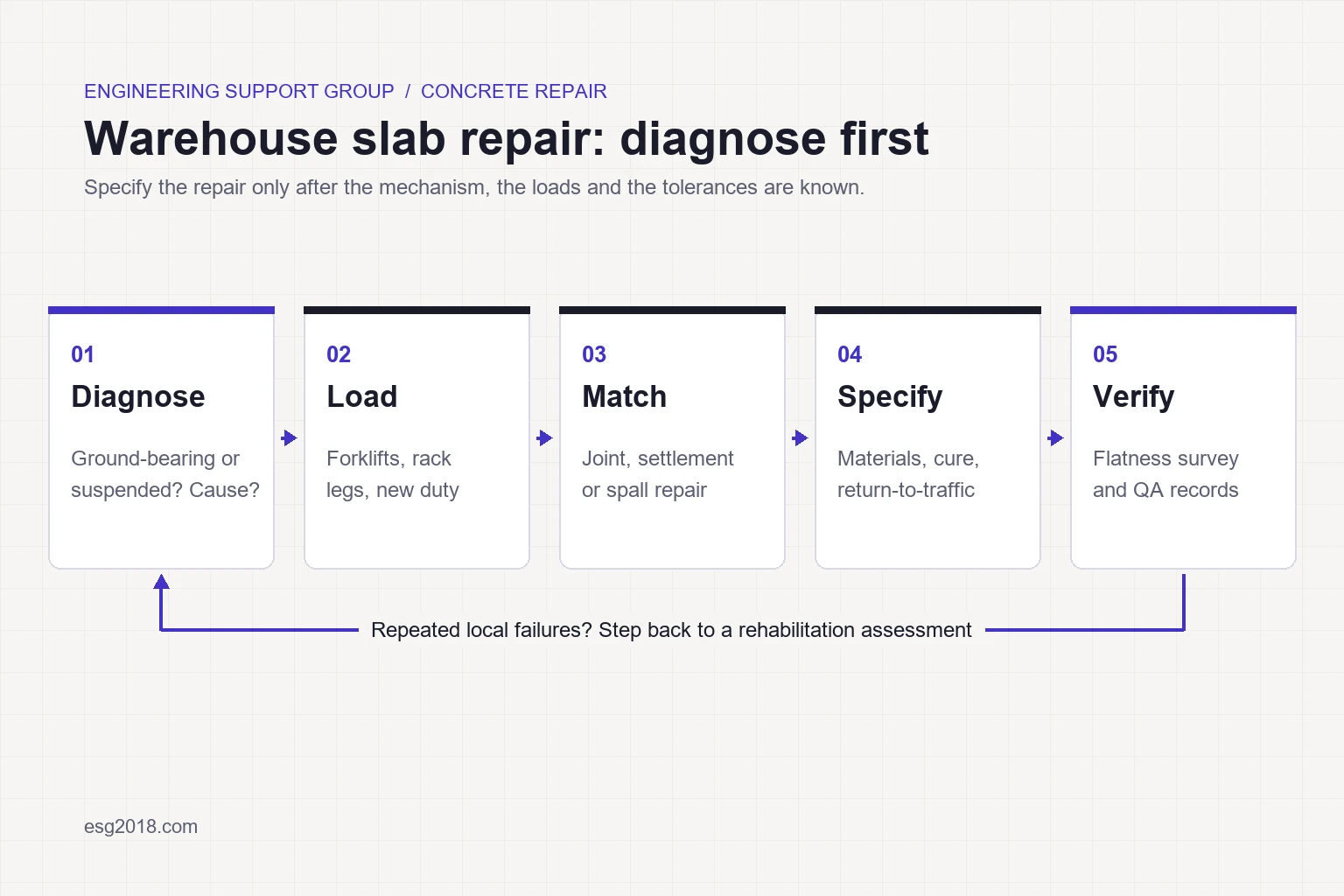
The investigation should first establish whether the slab is ground-supported or suspended. A ground-supported warehouse floor relies on the sub-base and subgrade for most of its capacity. Localised voiding, erosion, consolidation or poor compaction can therefore matter as much as the condition of the concrete itself. A suspended slab, by contrast, needs a different line of assessment: flexural behaviour, punching shear near concentrated loads, reinforcement condition, deflection and the capacity of the supporting frame.
A disciplined condition assessment combines document review, a walkover survey, crack mapping, a level survey and loading information. Original structural drawings, geotechnical records, concrete test data and previous repair history are valuable where they exist. In older facilities, these records are often incomplete, which makes measured evidence more important than assumptions.
Depending on the defect pattern, the engineer may call for core sampling, petrographic examination, covermeter scanning, ground-penetrating radar, moisture testing and proof of subgrade condition. Floor flatness and levelness measurements become essential where very-narrow-aisle trucks, automated storage and retrieval systems or high-bay racking operate. In short, the engineer should prove the repair design against the actual traffic and storage arrangement, not a generic warehouse load.
Warehouse Slab Repair Must Match the Defect
The engineer selects a repair method only after understanding the cause, extent and structural significance of the damage. Cosmetic crack filling may be reasonable for stable, non-structural shrinkage cracks outside critical wheel paths. It is the wrong response, however, to active movement or to a crack linked to settlement. Our overview of the best methods for concrete repair compares the main techniques across building types.
Warehouse Slab Repair at Joints
Joint failure is among the most common operational issues in warehouse floors. Broken arrises, loose joint fillers and differential vertical movement create impact loading at every wheel crossing. Over time, this damages forklifts, makes loads less stable and accelerates concrete deterioration.
A joint repair typically removes unsound concrete, reinstates the arris with a compatible high-strength repair material and restores the joint geometry. Where hard-wheeled traffic crosses the joint, the filler should be semi-rigid; ACI 302.1R recommends a Shore A hardness of at least 80 for this duty [2].
Compatibility also matters. For instance, a very rigid repair next to weaker concrete can shift failure to the edge of the repair. Conversely, a filler that is too soft may extrude or break down under hard-wheeled forklifts. The specified product must therefore suit the expected joint movement, concrete age, ambient temperature, cure period and actual wheel loading.
Warehouse Slab Repair After Settlement
Where a slab has settled, surface patching is rarely a durable answer. The engineer must first decide whether compaction grouting, resin injection, slab lifting, localised reconstruction, drainage correction or treatment of leaking services can stabilise the support. However, each option has limits. Slab lifting may restore the profile, but it does not resolve a weak or moisture-sensitive subgrade. Full-depth replacement gives a dependable result. Even so, the contractor must control dowelling, joint layout, curing and traffic management, or the new panel becomes a new point of weakness.
Spalling and Delamination
Similarly, spalling and delamination need care. Sounding surveys and selective breakout establish the true extent of defective concrete, as our guide to what causes concrete spalling explains. Repairs should continue to sound material, and the engineer should assess any exposed reinforcement for section loss and corrosion risk. For suspended slabs, the repair design must also account for how concrete removal affects local capacity and safety during the works.
Loading, Racking, and Floor Tolerances
Changes in use often trigger slab distress. A floor first used for general storage may later carry denser racking, battery-charging areas, heavier lift trucks, automated guided vehicles or concentrated machinery loads.
Rack leg loads need particular attention. Their effect depends on baseplate size, slab thickness, distance to the nearest joint, reinforcement and subgrade modulus. Impact and seismic actions on the rack add to it. Concrete Society TR34 sets out design checks for these concentrated loads on ground-bearing floors [1]. An engineer cannot treat a repair in isolation if the floor around the rack baseplates remains overstressed or unsupported. Load distribution plates may reduce bearing stress in some cases, but they are no substitute for a verified slab capacity check.
Forklift traffic also produces repeated dynamic action, especially at damaged joints and transitions. A repair detail should therefore state the strength required before traffic returns, not just the material’s final compressive strength. Fast-setting products shorten closures, yet they bring tighter placement control, higher shrinkage risk and higher cost. In hot climates, high ambient and substrate temperatures also shorten working time and dry the repair early. Curing then needs the controls described in ACI 305R [5]. The best choice depends on the shutdown window and the consequences of early traffic.
For high-tolerance operations, the engineer must check repaired areas against the facility’s operating criteria. Even a structurally sound repair can disrupt automated equipment if it leaves a ridge, a dip or an abrupt joint transition. TR34 classifies floor flatness for free-movement areas and for defined-movement aisles used by very-narrow-aisle trucks [1]. The repair package should state the flatness, levelness and transition tolerances, and the contractor should prove them by survey after completion.
Specify the Repair as a Controlled Construction Package
A technically sound warehouse slab repair can still fail through weak execution control. The specification should define the limits of removal, substrate preparation and edge cutting. It should also cover reinforcement treatment, repair material properties, bonding method, joint reinstatement, curing and acceptance testing. For repair mortars, EN 1504-3 provides performance classes (R1 to R4) that let the specification state structural or non-structural duty clearly [4].
Surface preparation is often decisive. Concrete contaminated by oils, tyre residues, curing compounds or dust will not give a reliable bond. Mechanical preparation should therefore achieve the required concrete surface profile without damaging adjacent sound material. The moisture condition must also suit the repair system: some resin-based materials need a dry substrate, while cementitious systems may need a saturated surface-dry condition.
Next, coordinate the sequence of work with warehouse operations. Establish exclusion zones, maintain emergency routes, isolate dust and agree temporary traffic paths before demolition begins. Repairs in principal aisles may need phased work outside peak dispatch periods. For facilities that run continuously, several short, controlled closures are often safer than one broad work area that nobody can properly segregate.
Finally, keep quality records for asset management: pre-repair condition photographs, survey data, batch certificates, ambient conditions, substrate preparation checks, repair thickness records, curing confirmation and post-repair level measurements. Together, these records give a defensible basis for handover and for future maintenance decisions.
When Repair Becomes Rehabilitation
Repeated local failures warn that the maintenance strategy may be too narrow. If joints are failing across several aisles, cracks are extending or floor levels are changing, the owner should commission a wider rehabilitation assessment. The outcome may include structural strengthening, selective slab replacement, improved drainage, revised traffic routes, rack reconfiguration or monitoring of movement over time.
Relevant criteria include TR34 for ground-bearing industrial floors [1], ACI 360R for slabs-on-ground [3], ACI 302.1R for floor construction and joint fillers [2], ACI 546R [6] and EN 1504 [4] for concrete repair, and the governing building code for the project. These references support engineering judgement; they do not replace it. An existing floor needs an assessment of its actual condition, constraints and duty cycle.
Quick Check Before Appointing a Warehouse Slab Repair Contractor
- Is the slab ground-supported or suspended, and has anyone confirmed it?
- Which mechanism caused the defect, and what evidence supports that diagnosis?
- Which loads will the repaired area carry, including rack legs and future equipment?
- How strong must the repair be before traffic returns?
- What flatness and levelness tolerances apply, and who will measure them?
- How will the contractor phase the work around live operations and emergency routes?
Engineering Support Group (ESG) is an engineering consultancy. We treat warehouse floor problems as asset-performance problems: inspect the mechanism, verify the loads, define the repair tolerances, and issue details that contractors can build and operators can maintain. The aim is a repair scope that is defensible to the owner, practical on site and proportionate to the facility’s risk.
The most useful next step is often a targeted engineering survey before anyone appoints a repair contractor. A clear diagnosis stops the owner paying for the same repair twice. It also gives the operations team a realistic plan for keeping the warehouse moving while the floor returns to service. To discuss a damaged floor, see our inspection and structural assessment services or contact our engineers.
References
- The Concrete Society (2013, reprinted with amendments 2018). TR34 Concrete industrial ground floors: a guide to design and construction, 4th edition.
- ACI Committee 302. ACI 302.1R, Guide to Concrete Floor and Slab Construction. American Concrete Institute.
- ACI Committee 360. ACI 360R, Guide to Design of Slabs-on-Ground. American Concrete Institute.
- EN 1504-3. Products and systems for the protection and repair of concrete structures. Part 3: Structural and non-structural repair. CEN.
- ACI Committee 305. ACI 305R, Guide to Hot Weather Concreting. American Concrete Institute.
- ACI Committee 546. ACI 546R, Guide to Concrete Repair. American Concrete Institute.