Structural Health Monitoring: What to Check Before You Commission a System
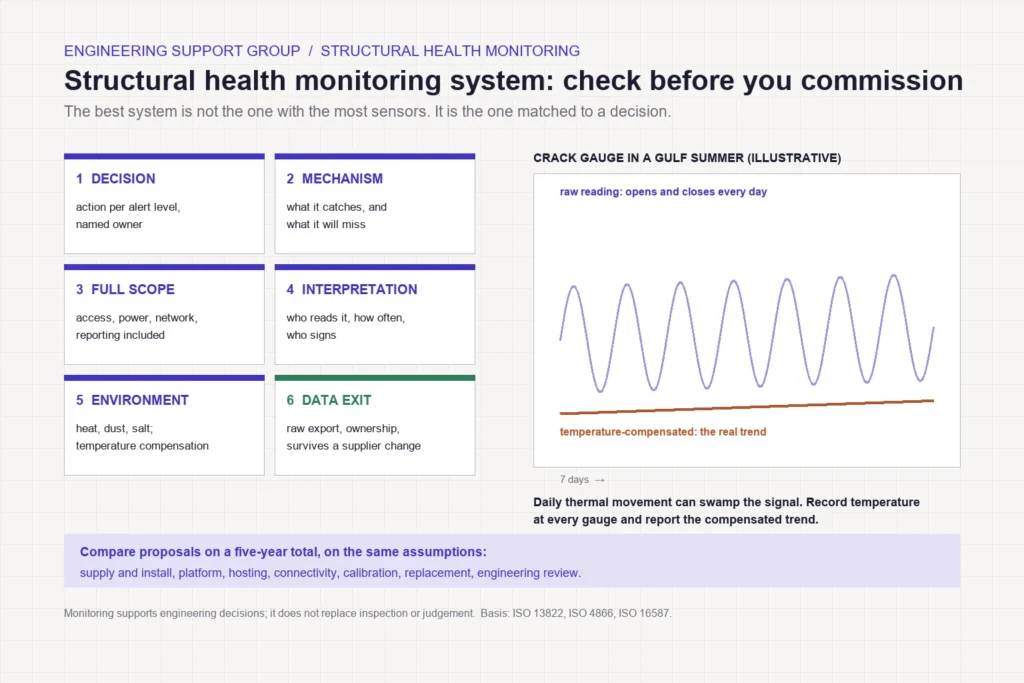
A monitoring proposal can look complete on paper and still leave the wrong system on the structure. The disappointments are rarely about sensor accuracy. Instead, they come from a system that measures something real but not the thing that governs. They also come from data nobody is contracted to interpret, or from a platform holding five years of readings you cannot export. That is the quiet truth about instrumenting an asset. The best structural health monitoring system is not the one with the most sensors. It is the one matched to a decision you actually need to make. This guide starts with the details that decide which is which.
What actually determines a good system, at a glance:
- The decision first: what you will do differently once the readings arrive
- The failure mode, not the catalogue: measure how the structure would genuinely deteriorate
- Sensors are the cheap part: installation, power, connectivity and interpretation carry the cost
- Someone has to read it: a monitoring contract without engineering is only a data contract
- Ownership and exit: raw data formats, platform access, and what happens at the end
- Site and regional realities: heat, dust, humidity, access and local approvals
Start a Structural Health Monitoring System With the Decision
Monitoring begins with a question, not a specification. Before comparing systems, write down the decision the data will support. It may be whether to keep a building in service, or whether a crack is still moving. It may be whether a repaired element can return to full load, or which of forty bridges gets next year’s budget. If nobody can say what the team will do differently when the readings arrive, the system will produce data that nobody acts on. Meanwhile, the cost continues every year.
This is also where structural health monitoring separates from assessment. An assessment gives you a verdict at a point in time. Monitoring gives you a trend, and a trend is only valuable against a threshold agreed in advance. ISO 13822, the basis for assessing existing structures, is the natural companion here [1]. It frames what you are trying to prove before you decide how to measure it.
Agree the Thresholds Before the First Sensor Goes In
A monitoring scope should state, in writing, the alert levels, who gets notified, how quickly, and what action each level triggers. Without that, an exceedance at two in the morning becomes an email that sits unread until Monday. So decide whether a breach means “review at the next monthly report”, “attend site within 24 hours” or “restrict occupancy now”. The engineering value of the system lives in that table, not in the sensor datasheet. For the seven questions an owner should put to any proposal, see the future of structural monitoring.
Be equally clear about the baseline. A structure instrumented after visible distress has no undamaged reference, so the first months of readings set the baseline rather than judge it. That is a legitimate outcome. However, set it as an expectation at the start, so it does not become a disappointment six months in. A load test at installation can give the baseline a known reference load.
Match the Structural Health Monitoring System to the Failure Mode
Each deterioration mechanism shows up in a different measurement. As a result, a system that is excellent for one mechanism can be nearly blind to another. The table matches the common mechanisms to what you should measure.
| Mechanism | What to measure | What to watch |
|---|---|---|
| Movement and settlement | Tilt, displacement, levelling | Slow sampling, but long-term stability |
| Crack activity | Displacement across the crack, plus temperature | Thermal breathing mistaken for growth |
| Fatigue at steel details | Strain at the detail | Sampling fast enough to capture real stress cycles |
| Reinforcement corrosion | Half-cell potential, resistivity | Shows corrosion activity, not section loss |
| Global stiffness change | Vibration and modal behaviour | Strong at whole-structure scale, weak for small local damage |
That last row deserves attention, because suppliers market vibration-based methods most heavily. They are genuinely strong for tracking overall condition over years, which is why they suit bridges and long-span assets. The approach we set out in predictive bridge health monitoring depends on spotting a change in signature against a stable reference. That is a different job from watching one crack in one wall. ISO 4866 covers vibration measurement on fixed structures, and ISO 16587 covers performance parameters for monitoring them [2][3]. For bridges, ISO 14963 and ISO 18649 add guidance on dynamic tests and on evaluating their results [4].
Here is the practical test for any proposal. Ask the supplier to name the deterioration mechanism the system should catch, and to explain what it would miss. A supplier who cannot answer the second half is selling hardware, not monitoring. Our comparison of SHM sensor systems covers the instruments in more depth.
The Sensor Is the Cheap Part
Hardware is usually the smallest line in a monitoring budget. The real cost sits in access for installation, cable routes and containment, power, enclosures rated for the environment, calibration and commissioning. On top of that comes the engineering time to turn readings into a conclusion somebody will sign.
Compare proposals on the full scope, not the sensor count. Some quotations list sensors and a dashboard, and leave installation, power and reporting as provisional sums. Those do not compare with a price for the whole delivery. Ask specifically what the price excludes: scaffolding and access equipment, builder’s work, mains connection, network provision, annual recalibration and sensor replacement.
Who Interprets the Data?
This question changes the value of a monitoring contract more than any other. A dashboard shows you numbers. An engineer tells you what they mean and accepts professional responsibility for saying so. Those are different services, yet suppliers often sell them under the same word.
Start by asking who reviews the data and how often. Then check the qualifications and professional indemnity cover behind the interpretation. Next, find out what a reporting cycle contains: raw plots only, or trend analysis against the agreed thresholds with a recommendation. Finally, ask what happens on an exceedance out of hours. If every answer is a platform feature rather than a named responsibility, you are buying telemetry. You will still need an engineer later.
Installation Realities: Power, Connectivity and Access
Power decides more of the design than most owners expect. Mains supply is dependable but needs a route and an isolator. Batteries free the layout but create a maintenance visit. A sensor that needs a mobile platform or a lane closure to reach will quietly become the most expensive point on the structure. Solar helps outdoors, though panels need cleaning, and the heat that comes with the sunlight derates them.
Connectivity is the second constraint. Wireless nodes cut installation cost but need a gateway with real coverage. Basements, plant rooms, box girders and deep foundations are exactly where coverage fails, so confirm it by survey, not by assumption. In occupied buildings, also confirm what the works mean for tenants: drilling, hot works permits, out-of-hours access and making good.
Quick check: for every sensor on the layout, ask how somebody reaches it in three years to replace a battery or recalibrate. If the answer involves closing a lane, hiring a platform or evacuating a floor, the maintenance cost has just outgrown the hardware. In that case, a slightly less ideal but reachable position may be the better choice.
What a Structural Health Monitoring System Costs Over Five Years
Monitoring is rarely a single purchase. The realistic figure is a five-year total. It usually combines an upfront capital element with recurring costs: supply and installation, then platform or licence fees, data hosting, connectivity, calibration, sensor replacement and the engineering retainer for reporting.
The shape of the cost matters as much as the total. A capital-heavy model suits an owner with budget available now and a long horizon. A subscription model spreads the cost and keeps the supplier engaged. Even so, check it against the monitoring period you actually need. Short-term monitoring during construction, demolition next door or a repair validation period has an end date. Paying for a platform beyond it is avoidable. Ask for the five-year total on every proposal, on the same assumptions, and compare those.
Regional Factors in the UAE and the Gulf
Environment is not a footnote here. Summer temperatures affect both the equipment and the structure, and the design must allow for both.
On the equipment side, check the operating range of the electronics, not just the sensor. Gateways, batteries and power supplies commonly fail before sensors do. Confirm the ingress rating for dust. For coastal and marine assets, also confirm how enclosures, fixings and cable glands resist salt-laden humidity.
On the structural side, thermal cycling in the Gulf produces daily movements large enough to dominate a raw signal. A crack that seems to open and close by a wide margin every day is usually reporting the weather, not deterioration. A credible system records temperature alongside the main measurement and compensates for it. Likewise, a credible report separates thermal response from genuine trend. If a proposal does not mention temperature compensation, treat that as a significant gap.
Approvals and coordination deserve early attention too. Instrumenting an asset in service can involve the approving authority, the operator and existing warranties or maintenance contracts. Confirm who must approve fixings into structural elements before you finalise the layout.
Data Ownership, Platforms and Exit
Monitoring builds a record that may outlive the contract, the supplier and the platform. Establish who owns it and in what form.
First, check whether you receive raw data or only processed output, and in which format. Second, check for export or an interface into your asset management, FM or building management systems. Third, find out what happens to the historic record if you change supplier, and whether the readings stay readable outside the original platform. A long baseline is one of the most valuable things a monitored structure has. Losing it at a contract change resets years of evidence.
Monitoring supports engineering decisions; it does not replace inspection or engineering judgement. Sensors report a few points on a large structure, and they report only what their position allows. Treat an alert as a reason to investigate, not as a verdict. Keep periodic inspection and structural assessment in the programme alongside the instruments, especially where a system presents its output in confident visual language. Our guide on how to plan structural inspections covers that side.
Structural Health Monitoring System Checklist
Before signing a monitoring scope, confirm six practical points:
- Decision: the action each alert level triggers, written down, with named responsibilities.
- Mechanism: the deterioration the system should catch, and what it will miss.
- Scope: the full delivered cost, with access, power, connectivity and reporting included.
- Interpretation: who reviews the data, how often, and who is professionally responsible.
- Environment: temperature compensation, ingress and corrosion protection suited to the site.
- Data: ownership, export format, and what survives a change of supplier.
Then give the engineering its proper place. A monitoring system is not a product you install and admire. It is an instrument that should quietly narrow uncertainty about an asset you are responsible for. The right one produces fewer numbers than you expected and more decisions than you thought possible. It earns its keep on the day it tells you something has changed while the fix is still inexpensive.
If you are scoping instrumentation for a building, bridge or industrial asset, Engineering Support Group (ESG) advises on structural health monitoring from the decision stage through specification, interpretation and reporting. If you are still deciding whether monitoring is the right response at all, read our companion piece on when instrumentation is justified.
References
- Assessment of existing structures: ISO 13822:2010, Bases for design of structures. committee.iso.org
- Vibration of fixed structures: ISO 4866:2010, Mechanical vibration and shock, guidelines for the measurement of vibrations and evaluation of their effects on structures. committee.iso.org
- Condition monitoring of structures: ISO 16587:2004, Mechanical vibration and shock, performance parameters. committee.iso.org
- Dynamic tests on bridges: ISO 14963:2003, guidelines for dynamic tests and investigations on bridges and viaducts, and ISO 18649:2004, evaluation of the measurement results. committee.iso.org