Condition Monitoring Versus Scheduled Maintenance
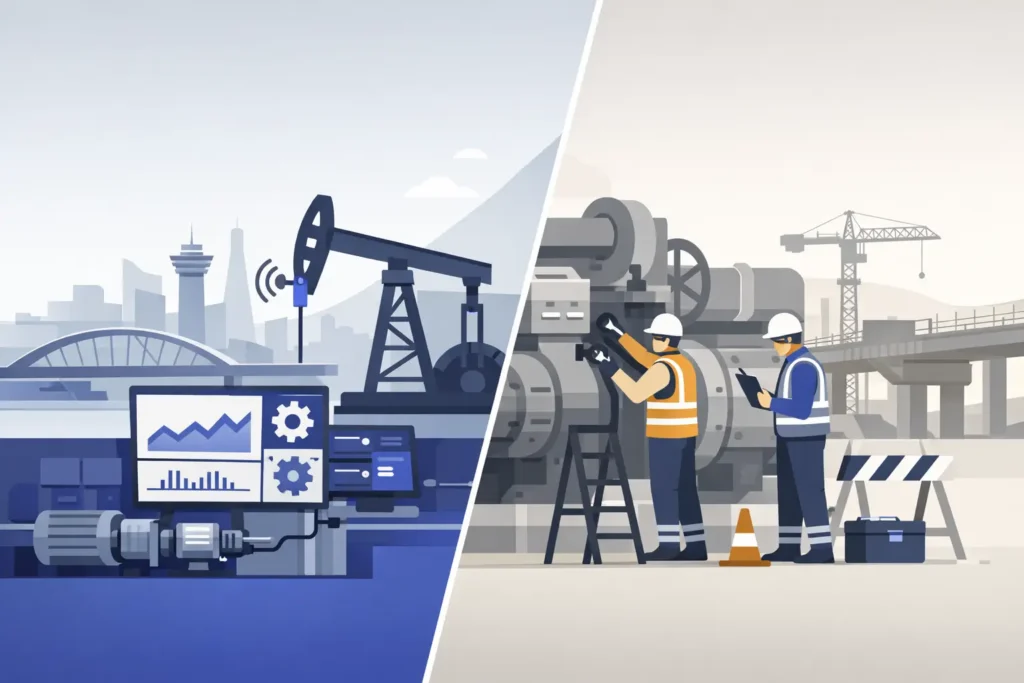
A bridge bearing that appears serviceable on a fixed inspection date can still be approaching a movement, corrosion, or alignment problem that changes its load path. Conversely, an HVAC air-handling unit may show stable vibration and temperature trends long after its nominal service interval has passed. That is the practical issue behind condition monitoring versus scheduled maintenance: deciding whether work should be triggered by elapsed time, measured asset condition, or a controlled combination of both.
For asset owners and public authorities, this is not a choice between modern technology and established maintenance practice. It is a question of risk control. The maintenance basis must be proportionate to consequence of failure, deterioration mechanism, inspection access, redundancy, and the reliability of the available data. A defensible strategy protects safety and service continuity while directing budget toward interventions that are technically justified.
Condition monitoring versus scheduled maintenance: the core distinction
Scheduled maintenance is performed at predetermined intervals. The interval may be defined by manufacturer instructions, statutory requirements, operating hours, inspection manuals, warranty conditions, or organizational experience. Examples include annual fire pump testing, periodic expansion-joint inspections, lubrication of mechanical equipment, and programmed cleaning of drainage systems.
Condition monitoring uses measured evidence to establish whether an asset is degrading and whether intervention is required. The evidence may come from visual inspection, crack mapping, corrosion potential surveys, vibration monitoring, displacement sensors, thermal imaging, ultrasonic testing, strain gauges, oil analysis, or building management system data. For bridges and structures, it can also include load-test response, settlement readings, joint movement, and changes in modal behavior.
The distinction is straightforward, but the implementation is not. A sensor record is not automatically a maintenance decision. It must be interpreted against a baseline, a credible deterioration model, operational loading, environmental exposure, and defined trigger levels. Equally, a calendar interval is not automatically conservative. If it causes unnecessary access works, equipment shutdowns, or replacement of sound components, it can reduce value without improving reliability.
Scheduled maintenance remains necessary for high-consequence tasks
Time-based maintenance is often the correct control where failure is sudden, degradation is difficult to observe, or a compliance obligation sets the minimum frequency. Fire and life-safety systems are an obvious example. Testing and certification cannot be deferred merely because no fault signal is present. The same principle applies to equipment with known consumables, filters, seals, batteries, lubricants, or sacrificial components that have predictable service lives.
For infrastructure, scheduled inspection also provides a repeatable baseline. A bridge, parking structure, retaining wall, or airport pavement needs periodic professional review even where monitoring is installed. Monitoring points only measure what they were designed to measure. They may not identify a new impact damage location, blocked drainage outlet, local concrete spall, unauthorized alteration, or defect outside the instrumented zone.
Scheduled maintenance is particularly effective when the following conditions apply:
- the failure mode is age-related and reasonably predictable;
- the task is low-cost and can be completed without major disruption;
- legislation, authority requirements, or manufacturer conditions prescribe an interval;
- condition cannot be measured reliably before functional performance is affected.
The weakness arises when fixed intervals become the only basis for decision-making. A uniform inspection cycle may treat critical and noncritical assets alike, overlook site-specific exposure, and offer little evidence for selecting repair scope. For aging assets, that can lead to reactive capital work after the deterioration has advanced beyond an economical repair stage.
What condition monitoring can change
Condition monitoring shifts the focus from performing a task to understanding performance. It is most valuable where the asset is critical, access is difficult, shutdown costs are high, or deterioration develops gradually enough for early warning to be useful.
Consider a post-tensioned slab in a heavily used building. Periodic visual inspection may identify cracking, water staining, deflection, and local distress. A condition-based program can go further by correlating those observations with moisture ingress, tendon risk locations, construction records, loading changes, and targeted non-destructive testing. The resulting recommendation is more precise: investigate a defined zone, repair the waterproofing source, verify tendon condition where justified, and monitor response after repair. This is materially different from assigning a generic repair allowance to the full floor plate.
For rotating MEP equipment, vibration and temperature trends can identify bearing degradation, imbalance, misalignment, or airflow restrictions before failure causes a shutdown. For electrical systems, thermal surveys and load data can help locate overheating terminations or recurring overload conditions. For road and bridge assets, remote monitoring can support decisions on settlement, expansion-joint movement, structural response, and the effects of abnormal loading.
The benefit is not simply fewer maintenance visits. It is better timing and better scope definition. Where data quality is high, condition-based decisions can reduce unnecessary replacement, prioritize limited budgets, and provide an audit trail for asset managers, insurers, and reviewing authorities.
Monitoring data must be engineered, not merely collected
A monitoring system should begin with a failure hypothesis. What behavior is being measured? What change would indicate unacceptable performance? How will the signal be separated from normal thermal movement, traffic loading, occupancy variation, seasonal humidity, or sensor drift?
For a structural health monitoring installation, a practical engineering plan defines the monitored elements, sensor types, sampling frequency, reference readings, data ownership, alert thresholds, review responsibility, and response actions. It also identifies what the system cannot establish. A strain gauge may show response trends, but it does not independently confirm reinforcement corrosion, concrete strength, or the integrity of every connection.
Thresholds require particular discipline. A threshold copied from another structure may be misleading because geometry, restraint, loading, temperature range, and foundation behavior differ. Alert levels should be set using design assumptions, baseline observations, expected operational variation, and an agreed escalation process. The critical question is not whether a dashboard changes color. It is whether the change requires inspection, operational restriction, detailed analysis, or immediate intervention.
This is where engineering judgment remains central. Data supports a decision, but it does not transfer accountability from the asset owner or engineer to the device.
Select the method by asset criticality and failure behavior
The most effective programs are hybrid programs. They retain scheduled statutory and preventive tasks while using condition evidence to refine interventions for selected assets. The correct balance depends on consequence and uncertainty.
A useful decision framework starts with four questions. First, what happens if the component fails: inconvenience, service interruption, injury risk, environmental impact, or structural instability? Second, is the dominant deterioration mechanism time-dependent, usage-dependent, or exposure-dependent? Third, can the condition be measured early enough to act? Fourth, what is the cost of inspection and intervention compared with the cost of unplanned failure?
A low-cost fan belt with a known service life may remain on a scheduled replacement cycle. A critical chilled-water pump serving a hospital may justify vibration monitoring, standby verification, and planned renewal based on actual condition. A bridge deck exposed to chlorides may require scheduled close visual inspections supplemented by condition surveys, cover measurement, chloride profiling, and targeted monitoring where cracking or leakage indicates active deterioration.
This distinction also affects procurement. A maintenance contract that rewards only task completion may encourage volume rather than asset outcomes. Requirements should define inspection competence, records, defect classification, response times, acceptance criteria, and escalation to structural or MEP engineering review. For major assets, the maintenance plan should connect directly to the asset register, risk ranking, inspection history, drawings, repair records, and future capital forecast.
Use condition evidence to make repair decisions defensible
Condition monitoring becomes commercially valuable when it improves the decision between repair, strengthening, replacement, and continued observation. That decision must consider residual capacity, serviceability, durability, operational demand, and remaining design life.
For an existing structure, an assessment may combine inspection findings with record drawings, material testing, load rating, and analysis to relevant standards such as ISO 13822, ACI, Eurocode, or AASHTO, as applicable to the asset and authority framework. Monitoring can reduce uncertainty in selected areas, but it does not remove the need for a properly defined assessment basis. A measured deflection trend, for example, should be evaluated against calculated behavior, occupancy loading, creep, temperature effects, and observed damage.
ESG approaches these programs as an engineering control loop: inspect, establish the governing mechanism, analyze the evidence, define intervention thresholds, and verify performance after repair or strengthening. This provides asset owners with recommendations that are proportionate to risk and defensible to any authority.
Avoid two common failures in maintenance planning
The first failure is over-monitoring. Installing sensors without a defined question, baseline, maintenance plan, or review process creates data volume rather than assurance. Instruments need calibration, power, communications, physical protection, and periodic validation. A failed sensor can produce false comfort if it is not detected.
The second is under-inspection. Asset teams sometimes assume that a stable dashboard eliminates the need for field inspection. It does not. The physical asset remains the primary source of evidence, especially where water ingress, accidental damage, workmanship defects, and localized distress are possible.
A mature program uses each method where it is strongest. Scheduled tasks ensure compliance and basic preventive control. Condition monitoring directs attention to changing risk. Detailed engineering assessment determines whether observed change affects safety, function, or remaining life.
The next maintenance budget should therefore begin with the assets that carry the greatest consequence, uncertainty, and replacement cost. Establish the inspection baseline first, then add monitoring only where it will change a real decision. That is how maintenance moves from a recurring expense to measured stewardship of the asset.